A 360° VIEW

Investors, innovators and adopters – see your whole AI ecosystem

You’re part of an AI value chain that’s expanding quickly and becoming more connected. A patchwork of critical infrastructure and resources, technologists, capital providers, regulators and customers with competing demands and expectations.

You see the pressures closest to you and manage the risks you can control. But it’s not always clear how fast-moving AI trends are playing out for your peers. Where tensions in one part of the ecosystem trigger risks in another. Or the reality behind headlines about valuation bubbles and policy changes.

MAPPING THE AI VALUE CHAIN

That’s why 2026 is The AI Year

DLA Piper conducted an investigation of the changing, nuanced and often hidden dynamics of the AI ecosystem from every angle – 12 months, 13 markets, 5 sectors and 3 different players. Here you’ll find regular updates of data and insight, giving you visibility into not just your own challenges, but the system-level issues affecting your partners and competitors.

Join us as we explore how the AI ecosystem is working for you, what’s on the horizon and ways to build a stronger value chain.

It’s easy to forget we are still in the early stages of the AI era. Future innovation will go faster and further in ways we can’t yet imagine. Anticipating those use cases – and their risks and opportunities – will be pivotal.

Gareth Stokes, Partner, Global Co-Chair, Technology and AI

Gareth Stokes

Gareth is Global Co-Chair of DLA Piper's Technology practice and part of the leadership team for DLA Piper’s global AI Practice Group.

We’re seeing a huge shift in attitudes as organizations analyze ROI on AI projects and learn where AI holds the most value for them. Less scattershot, more focused, greater staying power.

Erin Gibson, Partner, Global Co-Chair, Intellectual Property and Technology

Erin Gibson

Erin is Global Co-Chair of DLA Piper's Intellectual Property and Technology Practice.

Confidence is the fuel firing AI growth. It’s building momentum behind big investments and pivotal transactions, and pushing up risk tolerance.

Trenton Dykes, Partner, Global Co-Chair, Technology Sector

Trenton Dykes

Trenton is Global Co-Chair of DLA Piper's Technology sector, and the Seattle office managing partner.

The companies that are doing AI governance right are the ones who efficiently triage higher-risk AI applications and meaningfully document their testing. In contrast, those that point to off-the-shelf policies or paper tigers could be vulnerable to challenge.

Danny Tobey, Partner, Global Co-Chair, Data Analytics Practice

Danny Tobey

Danny is Global Co-Chair and Chair of DLA Piper Americas AI and Data Analytics Practice.

A STORY OF TWO HALVES

AI is running on confidence as risk rises across the value chain

We asked 975 top-level AI investors, innovators and adopters about their predictions and plans for AI in the first half of 2026. Results tell a story of two halves, with unshakeable optimism in AI masking underlying systemic dysfunction in how it’s financed, developed, regulated and protected. 

Continued momentum for AI deals and investment is a positive indicator, but shouldn’t be mistaken for a robust ecosystem. All players are accepting growing dependency, disruption and disputes risk to stay in the AI race. 

Part One Unshakeable optimism Read more
Part Two Underlying dysfunction Read more

As demand outstrips supply across the value chain, and organizations reach their bet-the-business inflection point with AI, many will prioritize speed over perfection. This opens the door to systemic risk, where one market shock, supplier failure or landmark dispute could change everything.

Jeanne Dauzier, Partner, Global Co-Chair, Artificial Intelligence and Data Analytics

Part One

Unshakeable optimism

AI deals are completing, investment is increasing and governance is highly rated. Leaders believe the ecosystem is stable – the majority don’t expect market shocks in the near future.

Confidence is the dominant market signal

79% of global leaders are confident in AI performance and investment returns and trust that AI will deliver projected gains.

The majority of leaders do not expect destabilizing events

The majority of investors, innovators and adopters are also optimistic about the stability of market conditions. Few think disruptive events are likely in the first half of the year, least of all a collapse in AI company valuations.

83%
EXPECT AI VALUATIONS TO HOLD FIRM
80%
EXPECT FUNDING MOMENTUM TO CONTINUE
73%
EXPECT PLATFORM CAPACITY TO REMAIN RESILIENT

Deal flow remains resilient

Transactional activity looks solid. In the final half of 2025, organizations completed an average of 24 AI deals. 23 further transactions were carried over into the start of 2026. Parties are seeing a 1:2 deal success rate, with strategic alliances most likely to get over the line and IP licensing deals the most challenging to close.

The biggest investors are making the boldest capital increases

Investment levels will be on average 14% higher in H1 2026 than the same time last year, with USD178 billion deployed to AI projects across the 975 organizations included in this research. Bold increases are happening at the top of the market, where the biggest investors will deploy 50%+ more capital.

Confidence in AI governance continues to grow
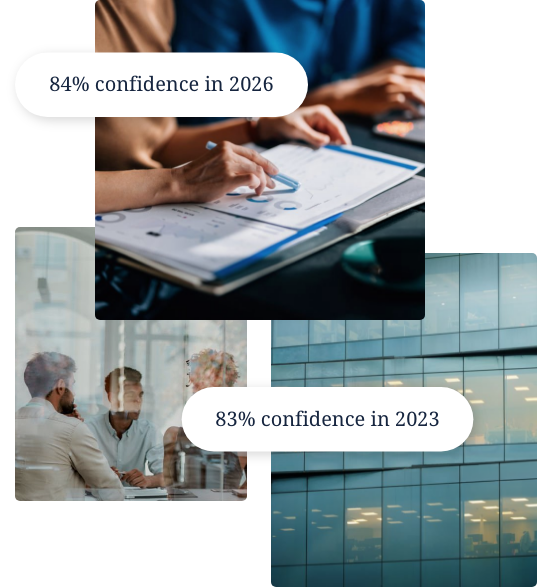
84% of global leaders say their organization’s governance is effective – a positive trend that continues from DLA Piper’s 2023 AI research.

Confidence in AI governance continues to grow

Momentum continues despite regulatory delays

The EU AI Act is a high regulatory bar for AI globally and has been beleaguered by disagreement and delay. But this hasn’t dented confidence. In fact, leaders are finding the positive. 76% say they’re clear on how the regulation applies to their business, and 70% predict a race to secure investment and deploy products before new dates are set.

Leaders may prefer to downplay the chance of a cyberattack or platform outage, but these events will be a part of the AI landscape in 2026. AI isn’t only an accelerator for commercial good; it can also create chaos.
JOHN MAGEE, PARTNER, GLOBAL CO-CHAIR DATA, PRIVACY AND CYBERSECURITY GROUP
Size matters in AI. Companies are leveraging a lot of capital to acquire bolt-on technology and expand their core product offering. It’s about growing faster, building a profile and winning customers.
PETER ARMSTRONG, PARTNER, ENERGY AND NATURAL RESOURCES
AI ambition may be limitless, but compute is finite. Data centers are no longer just real‑estate assets; they’re critical infrastructure for digital economies. Securing long‑term compute is becoming a strategic priority, but it must be balanced against supplier concentration, resilience, and sovereign‑risk exposure.
MARK BENNETT, PARTNER

Part Two

Underlying dysfunction

AI supply chains are increasingly brittle, and regulation, capital and geopolitics are concentrating market power and risk. IP protection is collateral damage in the drive for transparency, and AI use is a catalyst for contentious issues.

System under pressure

Behind the bullish outlook is a fragile and rapidly evolving AI ecosystem

As pressure builds across the AI value chain, innovators, investors and adopters are taking on greater risk to keep up. Supplier dependency, IP theft, data sovereignty, circular liability, litigation risk and cost of capital are impacting organizations in ways leaders aren’t fully aware of. Left undiscovered or unaddressed, these issues threaten to undermine AI gains. 

Don’t let confidence cloud your perspective on risk. Our research uncovers the seven pressure points you need to know.

Supply chain

Control, concentrate, risk, repeat

A value chain under strain

Entangled interests and growing dominance at the top of the market are weakening the AI value chain. 

72% of leaders say their network is increasingly interconnected and complex. Multiple suppliers are owned by the same parent company, and suppliers act simultaneously as investors and collaborators across the ecosystem, raising contagion risk.

Leaders also notice the same providers appearing across their value chain, indicating a shortage of suppliers with the capability and track record required to deliver AI projects.

Increased risks of disruption

Reliance on single suppliers for critical AI operations, particularly in the US, ramps up the risk of disruption further. 49% of companies across the AI ecosystem depend on one cloud provider and 42% have a single source for middleware and APIs. As a result, 67% agree that they are exposed to dependency risks in the AI value chain. 

To regain control, large LLM providers are looking upstream, buying up data centers and chip manufacturing capabilities. While integration deals can boost the resilience of individual supply chains, they’ll also increase concentration risk in the wider AI ecosystem. The cycle begins again.

72 %
Leaders say their AI network is increasingly complex
Dependence on a handful of suppliers is driving consolidation upstream

US suppliers dominate the market

With its advanced base of tech innovators, the US accounts for up to 35% of the global AI supply chain. China tops out at 24%.

Discover how to calibrate your enterprise risk strategy for an intertwined AI ecosystem

Companies need to think carefully about portability to avoid being locked into vendor relationships. If the risk landscape changes, or a shock event happens, you need to pivot quickly.

Vinny Sanchez, Partner, Global Co-Chair, Technology Transactions & Strategic Sourcing

Vinny Sanchez

Vinny is Global Co-Chair of DLA Piper’s Technology Transactions and Strategic Sourcing practice.

Geopolitics is truly baked into the AI market. Different countries and regulatory blocs are shaping access to chips, infrastructure and customers, forcing companies to make strategic choices about where they build, buy and partner. As AI development becomes more globally distributed, today’s concentration of influence will be tested.

Richard Sterneberg, Partner, Head of Global Government Relations

Richard Sterneberg

Richard is Head of Global Government Relations at DLA Piper.

There are a number of influential AI hubs now firmly established in the Gulf, and the region’s investors are playing a significant role in financing AI companies and digital infrastructure both internationally and at home. There’s clear ambition across the region to build on this reputation, from mega data centers to a growing number of state-backed AI start-ups.

Paul Allen, Partner, Global Co-Chair, Intellectual Property and Technology

Paul Allen

Paul is Global Co-Chair of DLA Piper's Intellectual Property and Technology practice.

Data

Cloud sovereignty means new heights for data governance complexity

Data and cloud sovereignty risks

Data is where geopolitics, regulation and commercial strategy collide. As AI becomes central to national security and economic strength, the push for sovereignty adds another dimension of complexity.

39% of leaders believe data and cloud sovereignty will be the biggest test of AI resilience in 2026, making it a top-three disruptor. 29% say tariffs and trade policy will also cause disruption, which is a rise of 10% on the previous year.

There is growing divergence between the US, Europe and the rest of the world on data obligations, limitations and policy. From use rights, consent and regulatory approval, to managing regulated information and moving data across international borders, these differences are making it more difficult to govern data globally.

Cybersecurity threats

As a result, stronger regional value chains will emerge, with domestic AI suppliers and digital infrastructure built to comply with local law. But duplication of AI tools multiplies the cybersecurity threat, which is already a top disruptor for 52% of innovators, adopters and investors.

39 %
Leaders say data and cloud sovereignty will be the biggest test of AI resilience
52 %
Identify cybersecurity threat as a top disruptor

Cyber and privacy issues are the biggest tests of organizational resilience

Cyber attacks show no sign of abating. 49% of leaders say data breaches will continue to be their top risk in the year ahead.

In China, the AI market will continue to provide a rich ecosystem of domestic providers. For multinationals, this gives confidence that data is managed in line with local law, shores up access to digital infrastructure and improves outcomes, investment and insights, as AI tools are trained on local data.

Carolyn Bigg, Partner, Global Co-Chair, Data, Cyber and Privacy

Carolyn Bigg

Carolyn heads DLA Piper’s APAC Data,
Privacy and Cybersecurity team.

Compare data rules across the world
Read more about rising to AI-enabled cyber-threats
Liability

When AI fails, accountability becomes a key concern

Liability risks

As organizations integrate AI deeper into core operations and product portfolios, the stakes for liability and safety couldn’t be higher. 

Organizations are trying to shift the burden, limiting their exposure through disclaimers and contractual liability clauses. 65% of leaders say liability is being passed along the value chain, and are unclear what recourse they may have if AI fails.

This strategy could have the opposite effect. Courts won’t tolerate an outcome where no one is accountable. Outside the US, there are new laws reversing burdens of causation and fault. US courts are also looking to traditional tort remedies for multi-defendant claims. 

Shared responsibility

To counter risk on the front end, improving product safety is a top priority for AI innovators. Testing tools in advance means companies can show their record of compliance and due care – and stop problems before they start. 

But AI safety and accuracy is not the sole responsibility of developers. It can fail at several stages. Adopters must also understand how the tools work so they can deploy them properly. While early litigation is currently focused on tech, risk will likely travel downstream to how AI is used by adopters.

65 %
Leaders say liability is being passed along the AI value chain

Confidence in governance masks a stubborn accountability gap

In 2023 we asked leaders what capabilities they were building to improve AI governance. Fast forward three years, and many are still striving for proper oversight and accountability for AI.

When parties across the value chain try to preemptively point the finger, instead of leaving no one accountable, it means everyone is accountable. Disclaimers and contractual liability provisions must be carefully crafted to satisfy courts that they're responsible and enforceable. A liability disclaimer that purports to do too much is as problematic as one that does too little.

Linzi Penman, Partner, Head of Technology Sector (UK)

Linzi Penman

Linzi heads up DLA Piper's
Technology sector group in the UK.

Regulation

Consolidating power and gatekeeping innovation

Market consolidation

Complexity of AI regulation and cost of compliance is pushing the market toward consolidation, reinforcing the power of large players. 

70% of leaders believe growing regulatory obligations are driving consolidation between AI companies as large players dominate the top of the market. Innovators are incentivized to get hyperscalers and corporate venturing arms involved early to secure the firepower they need to manage legal exposure. 

But this creates dependency when startups align their products and services closely with investor interests, rather than being led by innovation. 71% of leaders believe big cloud providers act as gatekeepers of AI innovation.

Regulatory uncertainty

Despite these concerns, there’s no consensus between innovators, investors and adopters on what an ideal regulatory standard looks like. Leaders recognize the difficulty of striking the right balance between innovation and protection, especially when technology is changing so quickly. But a majority believe the EU AI Act will hurt Europe’s competitiveness in the AI field.

70 %
Leaders believe regulatory obligations are driving consolidation
Leaders believe the EU AI Act will hurt Europe’s competitiveness in AI

A flight of talent, capital and innovation from the EU
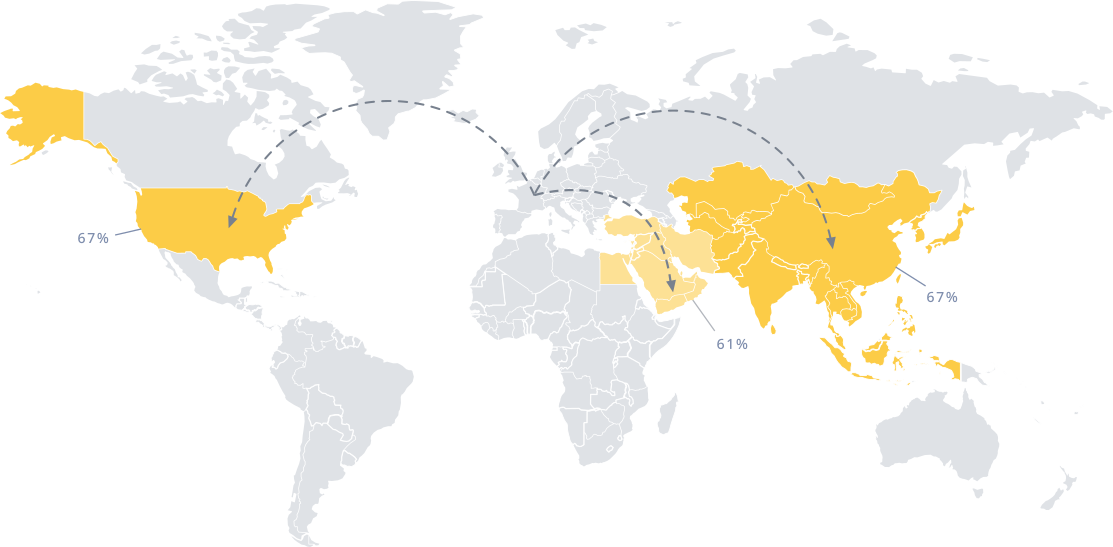
67% of leaders believe regulatory burden and uncertainty in Europe are pushing AI capital, talent and innovation to Asia and the US. 61% say the Gulf could also benefit, although this data was gathered before the recent conflict in Iran.

Competition authorities have been cautious on AI, even as power accumulates. Why? The AI ecosystem is varied, and dominance looks different in raw materials compared to software. The economics of AI and what amounts to consumer harm are also not yet clear. But we will start to see investigations, especially where regulators have a proven desire to exercise extraterritorial reach.

Gareth Stokes, Partner, Global Co-Chair, Technology and AI

Gareth Stokes

Gareth is Global Co-Chair of DLA Piper’s
Technology practice and part of the leadership
team for DLA Piper’s global AI Practice Group.

Explore international AI regulation
Who’s getting the balance right? Explore global data on regulation
Workplace

Companies exposed where AI meets the human factor

Rising litigation risk in AI deployment

AI at work means double the disputes risk for innovators, investors and adopters. Both employer and employee AI use is proving contentious. 

27% of leaders predict a major dispute or class action in 2026 related to how organizations deploy AI. There are several potential areas of risk, including restructuring and job displacement, appropriate human supervision of AI tools, and rights violations.

Union scrutiny of AI is also expected to reach a turning point this year, according to 26% of organizations. Unions are increasingly sophisticated negotiators on AI, calling for transparency and information sharing. We've already seen companies fined in Europe for failing to meet these obligations.

Policy gaps

At the same time, employee AI misuse is a growing driver of investigations, disciplinaries and disputes. And the policies designed to manage how people use AI may actually expose organizations to litigation risk. 70% of leaders believe their company needs to prepare for a wave of unfair dismissal cases arising from unclear, outdated and ill-conceived AI use policies. 


70 %
Leaders believe their company needs to prepare for AI-related dismissal cases

Employee misuse of AI is a significant factor in HR proceedings

AI use is already driving tribunals, internal investigations and disciplinary proceedings across every sector. For example, 65% of Financial Services leaders say employee conduct on AI has been the subject of internal investigation in the first half of 2026. 

AI is evolving from standalone chatbots into a digital workforce capable of automated decision making and unpredictable agent-to-agent interactions. A number of organizations are seemingly onboarding an entirely new workforce overnight. Managing that level of risk requires more than tools. It demands leadership buy-in and a funded, robust AI governance framework that's actively embedded in the strategy of the organization.

Sandra Oyewole, Partner, DLA Piper Africa

Sandra Oyewole

Sandra leads DLA Piper Africa's Intellectual
Property & Technology practice and co-leads its
Employment & Global Mobility practice.

Intellectual property

Rising theft demands strategies that balance protection and transparency

Risk of intellectual property theft

IP is suffering in the drive for open AI.

64% of innovators agree that explainability and model transparency is exposing them to IP theft – and 40% also see IP and copyright infringement claims as one of their biggest risks in 2026.

But regulatory direction and continued pressure from customers mean transparency is inevitable. 47% of innovators will focus on improvements to explainability and transparency in the year ahead, compared to 20% who plan to prioritize IP enforcement and patent protection. This indicates innovators prefer to get on the front foot to manage risk, rather than relying on litigation, which can be expensive, slow and reputationally sensitive.

The data suggests that existing protection strategies have not fully kept pace with the evolving regulatory and patent environment. As greater transparency around model development is contemplated, maintaining trade secret protection may become more challenging. In that context, some companies are beginning to reassess the role of patents in protecting AI-related software and models.

Mounting copyright pressure

At the same time, developers are defending multiple copyright claims themselves, draining resources and appetite to pursue enforcement litigation. In the US alone, there are currently around 80 active copyright cases against AI developers, creating a heightened state of controversy and driving licensing deals.

64 %
Innovators agree that model transparency is exposing them to IP theft
40 %
Innovators see IP and copyright infringement claims as one of the biggest risks in 2026

Tension between transparency and intellectual property theft

AI innovators in Africa, the Gulf, South Korea and China feel most exposed to IP theft as a result of growing explainability requirements.

Find out more about intellectual property licensing deal trends from our data

The environment for patenting AI-related software in the US is more favorable than it has been in years. As innovators are pushed towards transparency and look to alternatives to trade secret protection, there’s a real window of opportunity. But in a first-to-file system, waiting too long can mean losing protection altogether.

Larissa Bifano, Partner, Patent Development and Strategy

Larissa Bifano

Larissa is US Chair of DLA Piper’s Patent Development and Strategy practice.

Finance

Innovators squeezed
by capital costs

Risks of liquidity strain

Investor priorities for 2026 point to financial discipline, with capital deployed more selectively and liquidity strain pushed downstream. 

43% of AI investors will risk-manage portfolio growth in the coming year, investing in targets with a path to profitability, good margins, an ability to run on cheaper hardware and clear data ownership.

This tighter focus means securing working capital on good terms is a struggle for developers, despite rising investment levels. 72% say the cost of capital is going up because of AI bubble fears. 67% believe this will increase reliance on alternative funding from sovereign wealth, family offices and other unregulated capital providers.

72 %
Investors say the cost of capital is going up as a result of AI bubble fears

Where AI innovators are most concerned about capital availability

Securing sufficient working capital to power AI is a priority for 92% of leaders in India, followed by China and the UK (84%).

Venture capital and private equity remain AI finance powerhouses, especially in US tech centers. But as the market matures and other countries look to build AI independence, alternative investors will take on a larger role. We are already seeing sovereign wealth accelerate the AI influence of the Middle East.

James Iremonger, Partner, Head of Finance (Middle East)

James Iremonger

James heads DLA Piper's Middle East
Projects, Finance and Restructuring teams.

Call to action

KEY TAKEAWAYS FOR INVESTORS, INNOVATORS AND ADOPTERS

7 ways to protect value in the AI ecosystem

Your essential briefing on what conflicting AI market signals mean for your business. Plus strategies to strengthen your value chain and safeguard AI gains in a fast-moving market.

Download our sector reports

Our sector reports explore how leaders across Energy, Healthcare, Technology, Financial Services and Manufacturing are approaching AI adoption in practice, where momentum is accelerating, and where risk, scepticism or operational friction are beginning to emerge.

Coming soon ENERGY Why AI transformation is stalling in Energy

Legacy infrastructure and sensitivity to global shocks put Energy in a different position to other sectors. This report looks at the specific barriers leaders face, and where attention is focused.

Coming soon LIFE SCIENCES AND HEALTHCARE Life Sciences and Healthcare is moving fast on AI

63% of leaders are deploying AI for enterprise-wide strategy and transformation – more than any other sector. This report explores what’s driving that momentum, and the risks that come with it.

Coming soon TECHNOLOGY High expectations, higher pressure for Tech leaders

Technology companies are AI adopters as much as innovators. Reimagining their own services and operations, they hold their AI transformation to a standard their peers in other sectors simply don’t face.

Coming soon FINANCIAL SERVICES Financial Services: mature, integrated — and still exposed

60% of FS leaders are deploying AI for enterprise-wide transformation, with 77% saying it is fully embedded in operational systems. This report looks at where risk is building beneath that confidence.

Coming soon INDUSTRIALS AND MANUFACTURING Industrials and Manufacturing takes a harder line on AI

28% of leaders doubt AI will deliver projected gains – the highest of any sector. 26% think a market correction is coming. This report examines what’s behind the scepticism and what it means for the wider ecosystem.

DLA Piper can help you
maximize the impact of AI

We understand the risks and opportunities of creating and deploying game-changing technologies. Our lawyers and data scientists are already doing the work. From complying with an array of global regulations to ethics and everyday business decisions, our global team has you covered at every stage of the AI lifecycle.

For more information, get in touch.

Global key contacts

Gareth Stokes
Gareth Stokes
Partner, Global Co-Chair,
Technology and AI
Full bio
Jeanne Dauzier
Jeanne Dauzier
Partner, Global Co-Chair,
AI Practice
Full bio
Danny Tobey
Danny Tobey
Partner, Global Co-Chair,
AI and Data Analytics
Full bio

Asia Pacific

Mark Bennett
Mark Bennett
Partner
Full bio
Lauren Hurcombe
Lauren Hurcombe
Partner, Global Co-Chair,
Technology & Sourcing Group
Full bio

Europe, Middle East and Africa

Mark O'Conor
Mark O'Conor
Partner,
Managing Director for Sectors
Full bio
Jan Geert Meents
Jan Geert Meents
Partner
Full bio
Paul Allen
Paul Allen
Partner, Global Co-Chair,
Intellectual Property and Technology
Full bio

United States

Ashley Carr
Ashley Carr
Partner
Full bio
Trenton Dykes
Trenton Dykes
Partner, Global Co-Chair,
Technology Sector
Full bio
Erin Gibson
Erin Gibson
Partner, Global Co-Chair,
Intellectual Property and Technology
Full bio

Research methodology

The AI Year is an independent survey of AI investors (34%), innovators (33%) and adopters (34%) conducted in December 2025 and January 2026. Independent market researchers interviewed 975 CXOs, senior leaders and directors in AI, technology, strategy, investment and legal roles.

Back to top Back to top